Health Benefits of Outdoor Exercise vs Gym Workouts
You have a gym membership, a home treadmill, or a stack of workout DVDs. You are already exercising. So why would you bother going outside? Because a growing body of research suggests that where you exercise matters almost as much as whether you exercise at all. And the evidence overwhelmingly favors the outdoors.
Over the past decade, researchers at institutions from the University of Exeter to Stanford to the University of East Anglia have built a compelling case for what scientists now call "green exercise," physical activity performed in natural environments. The findings go well beyond fresh air. Outdoor exercise measurably changes your stress hormones, your mood chemistry, your long-term exercise habits, and even your social connections in ways that indoor workouts simply do not.
Outdoor exercise provides measurable health benefits beyond indoor gym workouts, including 20% greater reduction in cortisol levels, 30% longer mood improvement, higher vitamin D synthesis, and significantly better long-term exercise adherence. Research from the University of Exeter found that just 5 minutes of outdoor exercise produces measurable improvements in self-esteem and mood.
The Science of "Green Exercise": What Happens When You Move Outdoors
The term "green exercise" was coined by researchers Jules Pretty and Jo Barton at the University of Essex in 2003. Their initial studies found something surprising: the combination of physical activity and natural environments produced benefits that neither component delivered alone. Exercise is good. Nature exposure is good. But combining them creates a synergistic effect that exceeds the sum of its parts.
Cortisol and the Stress Response
A 2019 study published in Frontiers in Psychology measured salivary cortisol levels in participants who walked for 20 minutes in three settings: a nature trail, an urban street, and on a treadmill. The nature trail group showed a 20.4% greater reduction in cortisol compared to the treadmill group and a 14.6% greater reduction compared to the urban walkers. The researchers attributed this to what environmental psychologists call "soft fascination," the effortless attention that natural environments engage, which allows the prefrontal cortex to rest.
Serotonin, Dopamine, and Mood
Outdoor exercise triggers a broader neurochemical response than indoor exercise. Sunlight exposure stimulates serotonin production through the retinal-hypothalamic pathway, independent of the serotonin boost from exercise itself. A 2020 study in the International Journal of Environmental Research and Public Health found that outdoor exercisers reported positive mood changes lasting 30% longer than indoor exercisers performing identical workouts. The researchers hypothesized that the varied sensory stimulation of natural environments, birdsong, wind, changing light, engages the brain differently than the controlled monotony of a gym.
Attention Restoration Theory
Environmental psychologists Rachel and Stephen Kaplan developed Attention Restoration Theory (ART) in 1989, and it has since been validated by dozens of studies. The theory posits that natural environments restore "directed attention," the cognitive resource we deplete throughout the workday. Urban and indoor environments demand directed attention (watching for cars, navigating gym equipment), while natural environments engage "involuntary attention" through inherently interesting stimuli. A 2022 meta-analysis in Psychological Bulletin confirmed that nature exposure reliably improves cognitive performance, with the strongest effects on tasks requiring sustained attention and working memory.
When you combine physical activity with this attention-restorative effect, you get what amounts to a cognitive reset. A 2023 study at the University of Michigan found that a 50-minute walk in an arboretum improved working memory performance by 20% compared to an equivalent walk along a busy urban street.
Outdoor vs Indoor Exercise: Head-to-Head Comparison
To understand the practical differences, here is a research-backed comparison across seven key dimensions.
Stress Reduction
Outdoor exercise consistently produces greater reductions in cortisol, heart rate, and blood pressure than identical indoor exercise. A systematic review in Environmental Science and Technology analyzing 11 studies found that outdoor activity was associated with greater feelings of revitalization, increased energy, and decreased tension, depression, and anger compared to indoor activity.
Mood Improvement
Both outdoor and indoor exercise improve mood, but outdoor exercise improves it more and for longer. The University of Exeter's landmark study found that just 5 minutes of outdoor exercise produced statistically significant improvements in both self-esteem and mood. Indoor exercise required 20-30 minutes to produce comparable acute mood effects, and the effects dissipated faster.
Exercise Adherence
This may be the most important finding for long-term health outcomes. A 2021 study published in Health and Place tracked 1,893 adults over 12 months and found that those who exercised outdoors were 23% more likely to still be exercising at the end of the study compared to gym-only exercisers. The researchers identified two key factors: greater enjoyment and lower perceived exertion. Outdoor exercisers consistently reported that their workouts felt easier and more enjoyable, even when objective intensity measurements were identical.
Vitamin D Synthesis
Outdoor exercise provides direct sunlight exposure, which is the body's primary mechanism for vitamin D synthesis. An estimated 42% of American adults are vitamin D deficient, and the consequences extend beyond bone health to immune function, mood regulation, and muscle strength. Fifteen to twenty minutes of midday sun exposure on arms and face provides approximately 1,000 IU of vitamin D, equivalent to the recommended daily supplement dose. Gym workouts, regardless of intensity, provide zero vitamin D.
Social Connection
Exercising in public outdoor spaces creates opportunities for social interaction that private gym environments often do not. Parks, trails, and outdoor exercise areas are inherently communal spaces. A 2023 study in Social Science and Medicine found that adults who exercised in parks reported 40% more social interactions during their workout than those who exercised in gyms, even when both groups exercised at the same time of day.
Cost
The average American gym membership costs $58 per month, or roughly $700 per year. Parks are free. While some outdoor activities have equipment costs (cycling, for example), many of the most effective outdoor exercises, including walking, bodyweight circuits, Tai Chi, and yoga, require nothing beyond appropriate clothing and shoes.
Accessibility
There are approximately 10,000 gyms in the United States. There are more than 10,000 parks in New York City alone. The National Recreation and Park Association reports that 75% of Americans live within a 10-minute walk of a park. Parks accommodate all fitness levels, require no membership, and have no dress code. They are arguably the most accessible exercise infrastructure in existence.
The Social Dimension: Why Exercising in Parks Changes Everything
In 2023, the U.S. Surgeon General declared loneliness and social isolation a public health epidemic, estimating that the mortality impact of social disconnection is equivalent to smoking 15 cigarettes per day. Exercise is often recommended as a loneliness intervention, but the setting matters enormously.
How Community Forms Around Outdoor Movement
Something happens in parks that does not happen in gyms: strangers become acquaintances, and acquaintances become community. The mechanisms are well-documented by sociologists. Public outdoor spaces create what urban theorist Ray Oldenburg called "third places," environments that are neither home nor work, where informal social interaction naturally occurs.
When regular outdoor exercise groups form, they create what researchers call "weak ties," the broad social connections that sociologist Mark Granovetter identified as critical for wellbeing and community resilience. A weekly Tai Chi group in a park does not just improve balance; it knits a neighborhood together.
The Multigenerational Advantage
Gyms are age-segregated by design. The equipment, the music, the culture, and often the membership fees create implicit barriers for both older adults and children. Parks have no such barriers. A 70-year-old and a 7-year-old can practice the same movements in the same space, at the same time, at their own pace.
This multigenerational mixing has measurable benefits. A 2022 study in The Gerontologist found that older adults who exercised in intergenerational settings reported 25% higher satisfaction with their exercise program and were 31% more likely to continue after six months compared to those in age-homogeneous groups.
Accountability Without Pressure
Community exercise groups provide a form of gentle accountability that gym memberships cannot replicate. When you know that Maria and James and that couple with the golden retriever will be in the park Saturday morning, you show up. Not because you will be charged a cancellation fee, but because you are part of something. This social motivation is one of the strongest predictors of long-term exercise adherence.
5 Best Outdoor Exercises for All Fitness Levels
Not all outdoor exercises are equally accessible or evidence-based. Here are five that work for virtually anyone, ranked by their breadth of evidence.
1. Walking
The most studied exercise in human history. A 2023 meta-analysis in the European Journal of Preventive Cardiology found that walking just 3,967 steps per day (far less than the commonly cited 10,000) reduced all-cause mortality. Every additional 1,000 steps reduced mortality risk by a further 15%. Walking outdoors provides the added benefits of varied terrain, which improves proprioception and ankle strength, and environmental stimulation, which enhances cognitive benefits.
2. Tai Chi
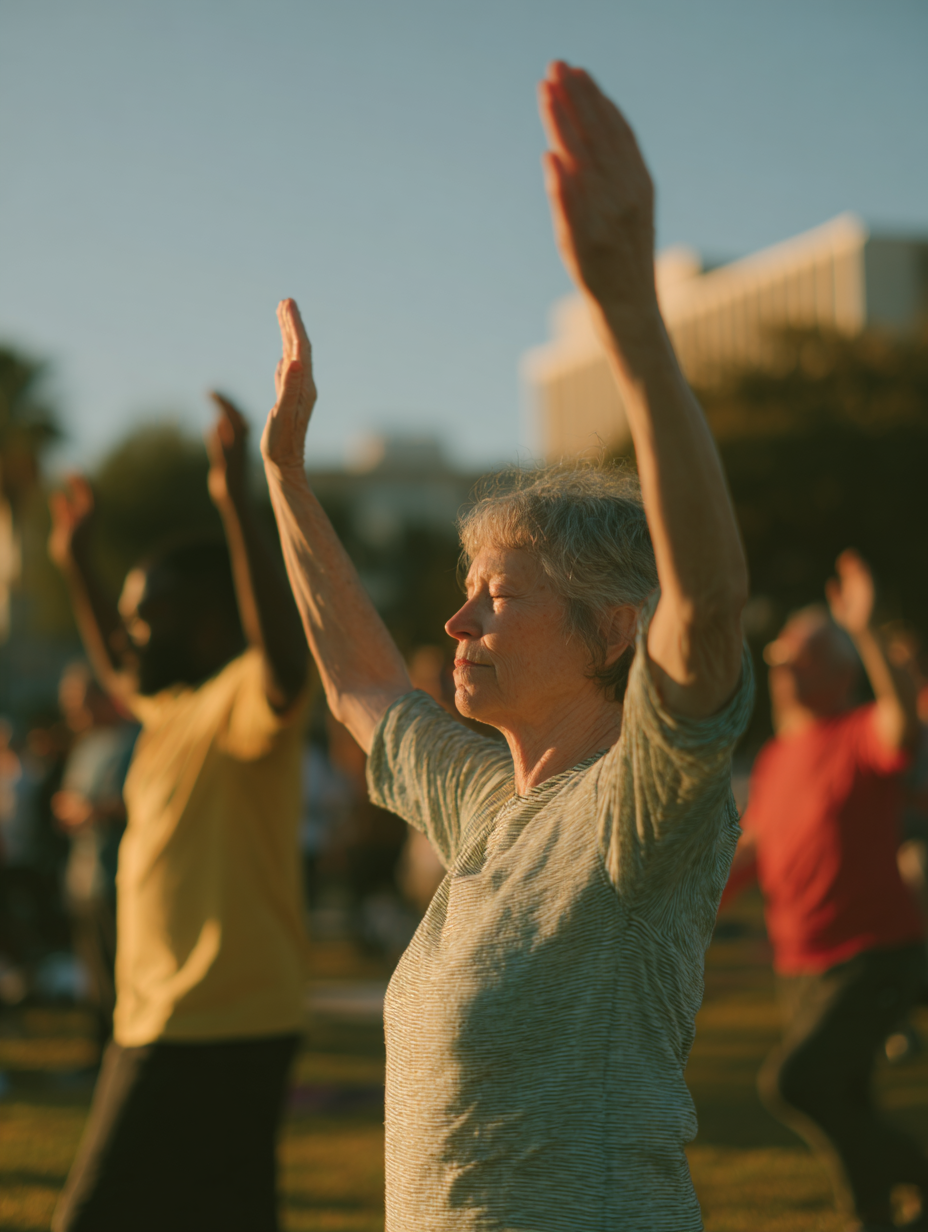
A systematic review in Medicine and Science in Sports and Exercise identified Tai Chi as one of the most effective exercises for balance, fall prevention, stress reduction, and blood pressure management. Its slow, deliberate movements make it suitable for all fitness levels, and its group practice model makes it inherently social. Practiced outdoors, Tai Chi combines the benefits of green exercise with community connection and mind-body integration.
3. Bodyweight Circuit Training
Park benches, playground bars, and open grass provide everything you need for a full-body workout. Research published in the Journal of Strength and Conditioning Research shows that bodyweight exercises like squats, lunges, push-ups, and step-ups produce comparable strength gains to machine-based exercises for beginners and intermediate exercisers. The variety of outdoor surfaces also engages stabilizer muscles that flat gym floors do not.
4. Yoga
Outdoor yoga combines flexibility and strength training with the attention-restorative benefits of natural environments. A 2020 randomized controlled trial found that outdoor yoga produced significantly greater reductions in anxiety and perceived stress compared to identical indoor sessions. The uneven ground of grass or sand also adds a proprioceptive challenge that improves balance.
5. Cycling
Outdoor cycling provides cardiovascular benefits comparable to spinning classes while covering distance, which adds exploration and variety. A 2022 study in Transportation Research found that people who cycled outdoors reported 45% greater enjoyment than stationary cyclists, and they exercised for an average of 13 minutes longer per session.
How to Start an Outdoor Exercise Routine
Transitioning from indoor to outdoor exercise, or starting an outdoor routine from scratch, requires some practical planning.
Weather Is Not the Barrier You Think
Scandinavian countries have some of the highest outdoor exercise rates in the world, and they also have some of the worst weather. The Norwegian concept of "friluftsliv" (open-air living) reflects a cultural commitment to outdoor activity regardless of conditions. Research from the University of Glasgow found that exercising in light rain or overcast conditions produced the same mood and stress-reduction benefits as exercising in sunshine. The key is appropriate clothing, not perfect weather.
Time of Day Matters
Morning outdoor exercise (before 10 AM) provides the strongest circadian rhythm benefits, helping regulate sleep-wake cycles through natural light exposure. However, any time outdoors is better than none. If mornings do not work for your schedule, afternoon or early evening outdoor exercise still provides significant benefits over indoor alternatives.
Finding Groups
Local parks and recreation departments often post group exercise schedules on their websites. Meetup.com lists outdoor exercise groups in most metropolitan areas. Many yoga studios offer outdoor sessions in summer months. And community organizations like Kelo offer structured programs specifically designed for outdoor group practice, with sessions that welcome all ages and fitness levels.
Park Safety
Choose well-maintained parks with clear sightlines. Exercise during daylight hours. Bring water, sunscreen, and a phone. Tell someone where you are going if you are exercising alone. These basic precautions address the most common concerns about outdoor exercise safety.
The Park Prescription: Doctors Are Now Prescribing Nature
What began as a fringe idea is becoming mainstream medical practice. Doctors in the United States, United Kingdom, and several other countries are now formally prescribing time in nature as a medical intervention.
The ParkRx Movement
ParkRx, a collaboration between the National Park Service, the CDC, and the Institute at the Golden Gate, provides a framework for healthcare providers to prescribe park time. The program has been adopted by health systems in more than 35 states. Physicians write a "park prescription" that specifies frequency, duration, and type of outdoor activity, just as they would for a pharmaceutical intervention.
A 2023 study evaluating ParkRx outcomes found that patients who received park prescriptions and actually filled them (by visiting parks at least twice weekly) showed significant improvements in blood pressure, BMI, anxiety scores, and self-reported quality of life over six months.
Green Social Prescribing in the UK
The United Kingdom's National Health Service has gone further, investing 5.77 million pounds in a "Green Social Prescribing" program that connects patients with nature-based activities including outdoor exercise groups, community gardening, and conservation volunteering. Early results from a 2024 evaluation showed that 70% of participants reported improved mental wellbeing, and the program was cost-effective compared to traditional interventions.
Insurance Coverage Trends
While most U.S. health insurance plans do not yet cover outdoor exercise programs directly, the trend is moving in that direction. Several Medicare Advantage plans now include gym membership benefits through SilverSneakers and similar programs, and there is growing advocacy to extend these benefits to community-based outdoor exercise programs. The economic case is straightforward: preventing a single fall-related hip fracture ($40,000 in medical costs) funds years of community exercise programming.
Making Outdoor Exercise a Habit
Knowing that outdoor exercise is beneficial is not the same as doing it consistently. Here is what the habit formation research says about making it stick.
The 66-Day Threshold
Research from University College London found that it takes an average of 66 days for a new behavior to become automatic. But that average masks enormous variation: simple habits form faster (18 days), while complex habits take longer (up to 254 days). The implication for outdoor exercise is clear: start simple. A 10-minute walk in the park is more likely to become habitual than a 60-minute outdoor boot camp.
Context Cues Over Motivation
Behavioral psychologist Wendy Wood's research at the University of Southern California demonstrates that habits are driven more by context cues than by motivation. Same time, same place, same trigger. If you walk in the park every Tuesday and Thursday after dropping the kids at school, the school drop-off becomes the cue that triggers the behavior. Within weeks, you will feel an urge to walk that has nothing to do with willpower.
Community as Commitment Device
The most powerful predictor of long-term exercise adherence is social commitment. A study in the Journal of Social Sciences found that people who exercised with a group were 95% more likely to complete a fitness program than those who exercised alone. This is why community-based outdoor exercise programs are so effective: they combine the benefits of green exercise with the commitment power of social obligation.
Programs that meet on a regular schedule in a consistent location, like Kelo's weekly park sessions, leverage every major habit formation principle simultaneously: a fixed time (context cue), a public space (reduced friction), a community of regulars (social commitment), and an accessible activity (low barrier to entry). The result is that people show up week after week, not because they are disciplined, but because the habit has become part of their identity.
Start This Week
You do not need to cancel your gym membership or buy new equipment. Just move one workout outside this week. Walk to a park instead of stepping on the treadmill. Try a bodyweight circuit on the grass. Join a community Tai Chi session. Notice how it feels different. Then do it again the following week. The evidence suggests that once you start, you will not want to stop.