Tai Chi for Seniors: A Complete Guide to Getting Started
Tai Chi is a low-impact mind-body exercise that improves balance by 31-50%, reduces fall risk, and eases chronic pain in adults over 60. Unlike gym workouts, Tai Chi requires no equipment, no minimum fitness level, and can be practiced anywhere — making it the most accessible exercise for seniors.
If you are over 60 and looking for an exercise that protects your joints, sharpens your mind, and keeps you socially connected, Tai Chi deserves your serious attention. This guide covers everything you need to know: the clinical evidence, the specific benefits, how to get started, and how Tai Chi compares to other popular senior exercises.
What Is Tai Chi and Why Is It Ideal for Seniors?
Tai Chi (sometimes spelled Taiji) is a centuries-old Chinese martial art that has evolved into one of the most studied forms of therapeutic exercise in modern medicine. It involves slow, continuous, flowing movements combined with deep breathing and mental focus. Each movement transitions seamlessly into the next, creating a moving meditation that engages the body and mind simultaneously.
What makes Tai Chi particularly well-suited for older adults comes down to biomechanics. The movements are performed standing, with both feet on the ground for most of the practice. There is no jumping, no sudden direction changes, and no impact loading on joints. Weight shifts happen gradually, giving your proprioceptive system time to adjust and respond.
Unlike yoga, which often requires getting down to and up from the floor, Tai Chi is performed entirely upright. Unlike swimming, it requires no pool or special facility. Unlike walking programs, it actively trains lateral stability and rotational balance — the exact movement patterns that prevent falls in daily life.
The intensity is entirely self-regulated. A practitioner can make the same form more or less challenging simply by adjusting stance depth, arm height, and speed. This means someone recovering from a hip replacement and someone training for a hiking trip can practice the same movements side by side, each getting an appropriate workout.
The Clinical Evidence: What Research Says About Tai Chi for Older Adults
Tai Chi is not a wellness trend lacking scientific support. It is one of the most rigorously studied exercise interventions for older adults, with evidence published in the world's leading medical journals.
A landmark 2019 systematic review published in the BMJ (British Medical Journal) analyzed data from 18 randomized controlled trials involving over 3,800 older adults. The review found that Tai Chi reduced the rate of falls by 31% and the number of people experiencing falls by 19% compared to control groups. These effect sizes are comparable to many pharmaceutical interventions for fall prevention, but without side effects.
The Journal of the American Geriatrics Society (JAGS) published a 2017 meta-analysis showing that Tai Chi significantly improved balance, gait speed, and lower extremity strength in adults over 65. Participants who practiced Tai Chi two to three times per week for 12 weeks showed measurable improvements across all functional fitness markers.
A 2020 Cochrane Review — considered the gold standard of medical evidence synthesis — examined 108 studies involving 7,014 participants. The review concluded that Tai Chi probably reduces falls compared to other interventions, and may improve balance and reduce fear of falling in older adults.
Research from Harvard Medical School's Osher Center for Integrative Medicine has documented Tai Chi's effects on blood pressure, with a 2021 study showing systolic blood pressure reductions of 10-15 mmHg in hypertensive adults who practiced Tai Chi for 12 weeks. For context, many blood pressure medications aim for reductions of 8-12 mmHg.
The National Institute on Aging (NIA) and the Centers for Disease Control and Prevention (CDC) both recognize Tai Chi as an evidence-based fall prevention program. The CDC includes Tai Chi Moving for Better Balance in its compendium of effective fall prevention interventions.
7 Proven Health Benefits of Tai Chi for Seniors
1. Balance and Stability
Tai Chi trains three balance systems simultaneously: proprioception (your body's awareness of its position in space), the vestibular system (inner ear balance), and visual processing. Most exercises train only one or two of these. A 2019 study in Age and Ageing found that 24 weeks of Tai Chi practice improved single-leg stance time by an average of 12 seconds — a clinically meaningful improvement that translates directly to fall risk reduction.
2. Fall Prevention
Falls are the leading cause of injury-related death among adults over 65, and one in four older Americans falls each year according to the CDC. The BMJ systematic review documented fall rate reductions of 31-50% among Tai Chi practitioners. This is not marginal — it represents a meaningful reduction in one of the most dangerous health risks facing older adults.
3. Joint Pain and Arthritis Relief
A 2016 study published in the Annals of Internal Medicine compared Tai Chi to standard physical therapy for knee osteoarthritis. After 12 weeks, both groups showed similar improvements in pain and function, but the Tai Chi group also reported better psychological well-being. The Arthritis Foundation has endorsed Tai Chi as a recommended exercise for arthritis management.
4. Blood Pressure Reduction
Hypertension affects nearly 75% of adults over 65. A 2020 meta-analysis in Medicine reviewing 28 trials found that Tai Chi practice produced average reductions of 12.4 mmHg systolic and 5.2 mmHg diastolic blood pressure. These effects were most pronounced in participants who practiced three or more times per week.
5. Cognitive Function and Memory
Learning and remembering Tai Chi forms engages working memory, spatial reasoning, and motor planning — cognitive functions that decline with age. A 2020 study in the Journal of Alzheimer's Disease found that 26 weeks of Tai Chi practice improved cognitive function scores by 1.5 points on the Montreal Cognitive Assessment (MoCA) in adults with mild cognitive impairment, compared to no change in the control group.
6. Sleep Quality
Insomnia and poor sleep quality affect up to 50% of older adults. A 2021 systematic review in Sleep Medicine Reviews found that Tai Chi improved subjective sleep quality in 82% of studies reviewed, with effect sizes comparable to cognitive behavioral therapy for insomnia (CBT-I). The combination of physical exertion, controlled breathing, and mental focus appears to help regulate circadian rhythms naturally.
7. Social Connection and Mental Health
The U.S. Surgeon General declared loneliness a public health epidemic in 2023, noting that social isolation has health effects equivalent to smoking 15 cigarettes daily. Group Tai Chi practice addresses this directly. A 2022 study in BMC Geriatrics found that older adults who practiced Tai Chi in groups reported 34% lower rates of depressive symptoms compared to those who exercised alone. The communal, non-competitive nature of Tai Chi makes it particularly effective at building social bonds.
How to Start Tai Chi: A Beginner's Roadmap
What to Wear
Tai Chi requires no special clothing or equipment. Wear loose, comfortable clothing that allows free movement — think elastic-waist pants and a relaxed-fit top. Footwear should be flat-soled shoes with good grip. Many practitioners prefer thin-soled shoes or dedicated Tai Chi shoes, but any flat sneaker works for beginners. Avoid thick-heeled running shoes, as they reduce ground feel and can affect balance.
Where to Practice
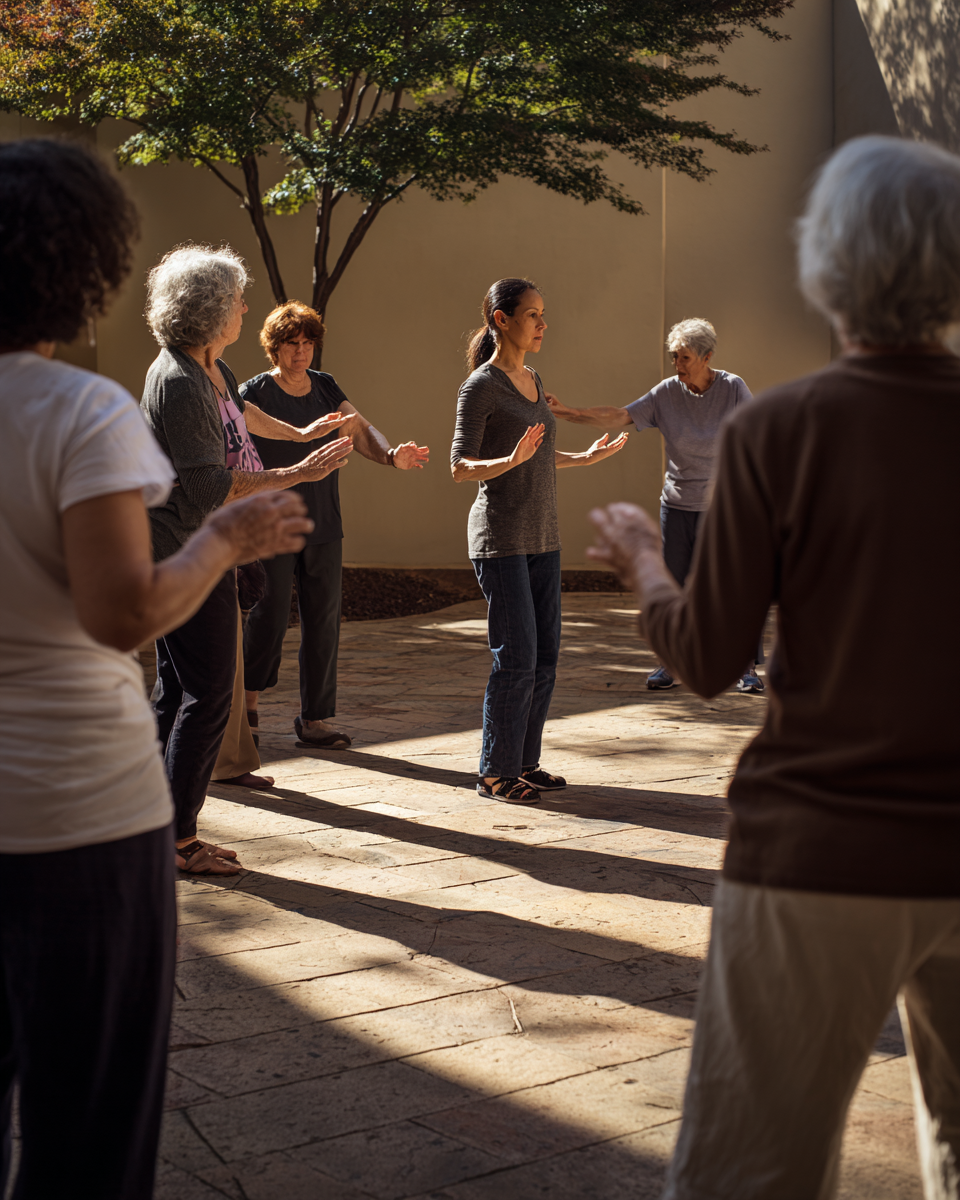
Any flat, open space works. You need roughly a 6-by-8-foot area. Parks, patios, living rooms, and community centers are all suitable. Outdoor practice has additional benefits: natural light exposure supports circadian rhythm, uneven ground subtly challenges balance, and fresh air improves respiratory function. Many practitioners find that outdoor practice also enhances the meditative quality of the movements.
Group Classes vs. At-Home Practice
Research consistently shows that group practice produces better outcomes than solo practice, primarily because of the social accountability factor and the ability to observe and learn from others. However, any practice is better than no practice.
For beginners, starting with a group class is ideal because an instructor can correct form in real-time. Once you learn the basics, supplementing with at-home practice between group sessions accelerates progress. Modern tools like camera-based pose tracking can provide form feedback during home practice, bridging the gap between group instruction and solo sessions.
How Often and How Long
Research suggests that two to three sessions per week, 20-30 minutes each, is sufficient to achieve measurable health benefits. However, even a single 10-minute session produces acute effects on blood pressure, mood, and perceived energy. The key is consistency over duration — five 10-minute sessions per week is more beneficial than one 50-minute session.
Choosing a Style
The most common styles taught in community settings are Yang style (the most popular, characterized by large, gentle movements), Sun style (designed specifically for older adults, with higher stances and less bending), and Wu style (compact movements suitable for smaller spaces). For seniors, Yang and Sun styles are the most recommended starting points.
Tai Chi vs Other Senior Exercises: How It Compares
To help you understand where Tai Chi fits among popular exercise options for older adults, here is a detailed comparison:
- Tai Chi: Impact level is very low. Equipment needed is none. Balance training is excellent (trains all three balance systems). Fall prevention evidence is strong (31-50% reduction). Social component is high in group settings. Accessibility requires no minimum fitness level. Joint stress is minimal. Cost to start is free (community classes available).
- Yoga: Impact level is low to moderate. Equipment needed is a mat. Balance training is good but involves floor transitions. Fall prevention evidence is moderate. Social component is moderate. Accessibility requires getting to and from the floor. Joint stress is low to moderate (some poses challenge wrists and knees). Cost to start is low to moderate (studio classes $15-25 per session).
- Walking: Impact level is low. Equipment needed is shoes. Balance training is minimal (forward motion only). Fall prevention evidence is limited. Social component is moderate with a walking partner. Accessibility is high. Joint stress is low but repetitive. Cost is free.
- Water Aerobics: Impact level is very low. Equipment needed is pool access. Balance training is limited (buoyancy reduces balance challenge). Fall prevention evidence is limited (balance skills do not transfer well to land). Social component is high. Accessibility is good but requires pool access and comfort in water. Joint stress is minimal. Cost is moderate ($5-15 per session plus facility membership).
- Strength Training: Impact level is moderate. Equipment is weights or machines. Balance training is limited. Fall prevention evidence is moderate (strengthens muscles but does not train balance reactions). Social component is low. Accessibility requires gym knowledge and often supervision. Joint stress is moderate to high. Cost is moderate to high.
Tai Chi stands out because it is the only exercise on this list that simultaneously trains balance, provides strong fall prevention evidence, requires no equipment or special facility, and has no minimum fitness prerequisite. Walking comes close in accessibility but lacks the balance training component. Water aerobics is gentle on joints but balance gains do not transfer to land-based activities.
Common Concerns and Myths About Tai Chi for Seniors
"I am not flexible enough for Tai Chi"
Tai Chi does not require flexibility. Unlike yoga, there are no stretches that demand a particular range of motion. All movements can be performed within your current range. Flexibility may improve over time as a result of practice, but it is never a prerequisite.
"Tai Chi is too slow to be real exercise"
Slow does not mean easy. Tai Chi's slow, controlled movements require sustained muscular engagement — particularly in the legs, core, and stabilizer muscles. Studies using accelerometry have shown that Tai Chi produces moderate-intensity physical activity levels, comparable to brisk walking. The slow speed is by design: it challenges balance, builds strength through time-under-tension, and trains neuromuscular coordination.
"I have bad knees and cannot do Tai Chi"
Tai Chi is actually recommended for people with knee osteoarthritis by both the American College of Rheumatology and the Arthritis Foundation. The gentle, low-impact movements can strengthen the muscles surrounding the knee joint without the impact loading of walking or running. If you have knee concerns, start with a higher stance (less knee bend) and work with an instructor who can modify movements for your needs.
"I need to learn Chinese philosophy to do Tai Chi"
Modern Tai Chi classes, especially those in community health settings, focus on the physical movements and their health benefits. While Tai Chi has deep philosophical roots, you do not need to study Chinese philosophy, understand qi theory, or learn Mandarin to benefit from the practice. Many evidence-based Tai Chi programs, such as Tai Chi for Arthritis and Tai Chi Moving for Better Balance, are designed specifically as health interventions with no philosophical requirements.
"I am too old to start"
Clinical trials have included participants in their 80s and 90s who showed meaningful improvements in balance and function. A 2018 study in JAMA Internal Medicine demonstrated benefits in adults aged 70-97. There is no upper age limit for starting Tai Chi. If you can stand and shift your weight from one foot to the other, you can practice Tai Chi. Chair-based modifications exist for those with limited standing ability.
Finding Tai Chi Classes Near You
The easiest way to start Tai Chi is to find a local class. Here are several approaches to finding one:
Community centers and senior centers: Many municipal recreation departments and senior centers offer Tai Chi classes at low or no cost. These are often taught by certified instructors using evidence-based curricula. Check your local parks and recreation department website.
Hospital and health system programs: Many hospitals and health systems offer Tai Chi as part of their wellness programming, particularly for fall prevention. These classes are often covered by Medicare Advantage plans or offered at subsidized rates.
YMCA and community fitness organizations: The YMCA and similar organizations frequently include Tai Chi in their group fitness schedules. Membership-based pricing applies, but financial assistance is often available.
Free community park sessions: A growing movement of free, outdoor Tai Chi sessions is making the practice more accessible than ever. Kelo Wellness runs free weekly park sessions across the United States, specifically designed to be welcoming to seniors, families, and complete beginners. These outdoor sessions combine the health benefits of Tai Chi with the added advantages of nature exposure and community connection — no registration, no fee, just show up.
Online and app-based options: If you prefer to start at home before joining a group, several apps now offer guided Tai Chi instruction. Look for programs that include real-time form feedback, which helps compensate for the absence of an in-person instructor. Kelo's app uses phone-camera-based AI pose tracking to provide form guidance during home practice, making solo sessions more effective without requiring any wearable device.
Whichever path you choose, the most important step is the first one. Tai Chi's benefits are cumulative and begin from the very first session. Whether you are 60 or 90, whether you exercise regularly or have not moved purposefully in years, Tai Chi meets you exactly where you are — and it takes you further than you might expect.