Tai Chi: A Complete Guide to Getting Started
Tai chi is a slow, continuous movement practice done standing. All it asks for is room to stand, clothes you can move in, and a pace you set yourself, which is why community centers, hospitals and parks departments run it as a group class.
This guide covers what tai chi is, what a first class feels like, what to wear, where to practice, how often, and how to find a class near you.
What tai chi is
Tai chi (sometimes spelled taiji) is a centuries-old Chinese martial art that is now taught mostly as a movement practice. It is built from slow, continuous, flowing movements combined with deep breathing and attention to what your body is doing. Each movement runs into the next, so a form plays more like one long phrase than a set of repetitions.
The biomechanics are what make it easy to walk into. The movements are performed standing, with both feet on the ground for most of the practice. Steps stay low, direction changes arrive gradually, and the joints carry only your own body weight. Weight shifts happen slowly, which gives your balance time to respond.
Compared with other group practices: yoga usually involves getting down to the floor and back up, swimming needs a pool, and a walking program trains forward motion only. Tai chi is done upright, works in any open space, and spends most of its time on lateral and rotational weight shifts, which is the part of balance you use when you turn around in a kitchen.
The intensity is self-regulated. The same form gets easier or harder depending on how deep you stand, how high you carry your arms, and how slowly you move. That is why one class can hold someone rebuilding after a hip replacement and someone training for a hiking trip, doing the same movements side by side.
What health agencies say
Two U.S. public health bodies publish guidance that mentions tai chi by name, and both are worth reading directly rather than through a summary.
The National Institute on Aging groups tai chi with practices that combine balance, movement and attention, and says they can build strength and help prevent falls and fall-related fractures. Its guidance also covers the parts of balance that have nothing to do with exercise: getting your eyes and hearing checked, sleeping enough, and limiting alcohol.
The CDC runs a fall prevention program for clinicians called STEADI, built around three steps: screen for fall risk, assess the specific risk factors, and intervene with something tailored to the person. Exercise is one of the interventions. If you want to know where you personally stand, STEADI's patient and caregiver materials are free and are the right starting point to bring to a doctor's appointment.
Neither source promises a number, and neither will this guide. What both make clear is that balance is trainable and that a practice you keep doing beats a better practice you quit.
What a first class feels like
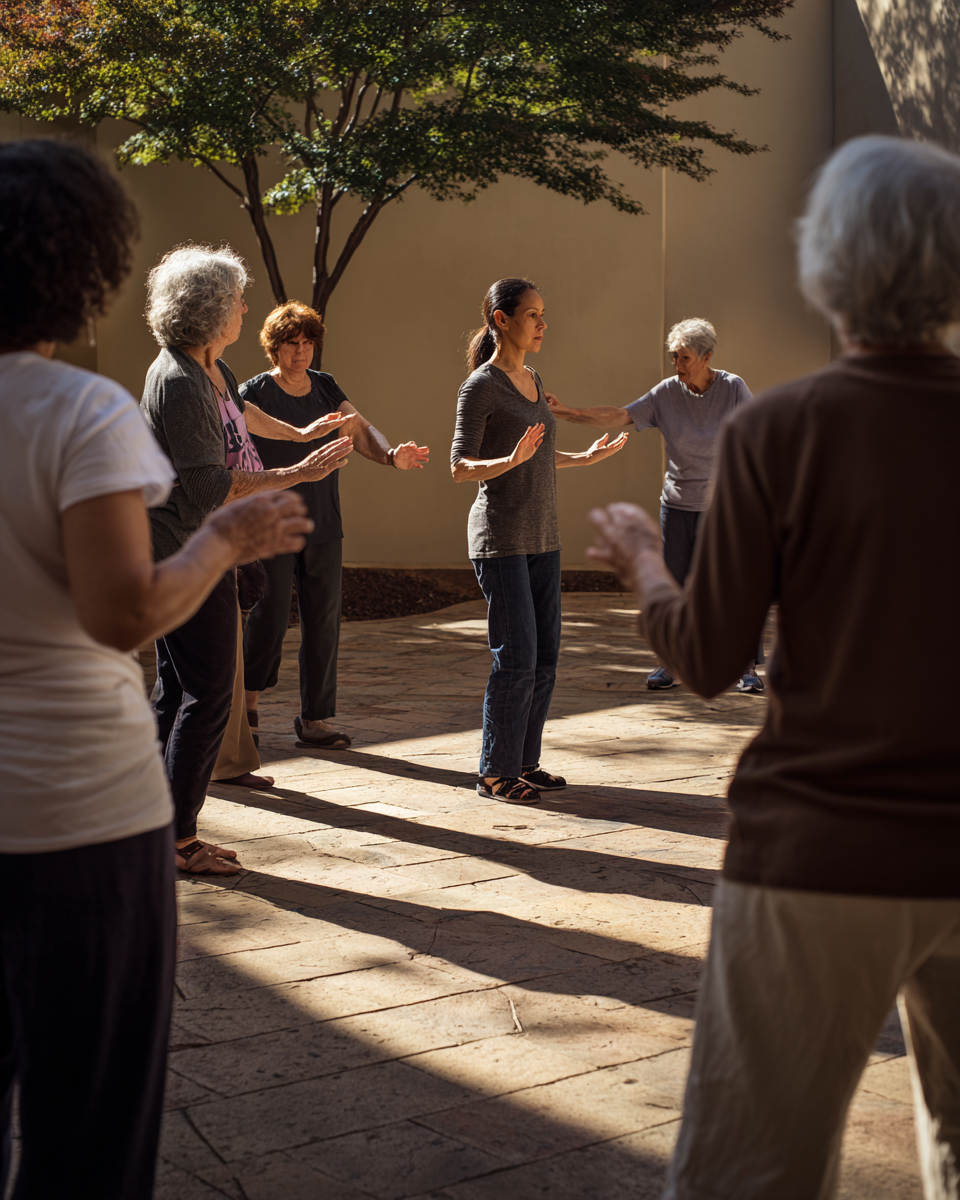
Most beginner classes open with a few minutes of standing and breathing, then walk through two or three movements very slowly, then repeat them until the shape settles. Nobody expects you to know the sequence. In a good class the teacher faces the same direction you do for most of the hour so you can copy, and calls the weight shifts out loud.
You will probably feel your legs more than you expect and your arms less. That is the practice working as designed: the legs carry the weight shifts, and the arms mostly ride along.
How to start
What to wear
No special clothing or equipment. Loose, comfortable clothes you can move in, and flat-soled shoes with grip. Many people prefer thin soles because you can feel the ground through them. Thick-heeled running shoes are the one thing worth avoiding, since they tilt you forward and mute the ground.
Where to practice
Any flat, open space about six feet by eight feet. Parks, patios, living rooms and community centers all work. Practicing outside adds daylight, fresh air and slightly uneven ground, which quietly makes the balance work harder.
Group class or at home
Start in a group if you can. A teacher corrects a stance on the spot, which is the one thing you cannot do for yourself, and a fixed time on a calendar is the part most home practices are missing. Once the basics are in your body, practicing between classes is what moves things along.
How often, how long
Two or three times a week is what most community programs schedule. Short and frequent is easier to keep than long and occasional, and keeping it is the whole point: balance answers faster when you ask it the same question often.
Choosing a style
The styles taught most often in community settings are Yang style, which has large, gentle movements and is the most widespread; Sun style, which uses higher stances and less knee bend; and Wu style, whose movements are compact enough for a small room. Yang and Sun are the usual starting points. If a class is listed as a 24-form or 8-form, that is the number of movements in the sequence, not a difficulty rating.
Common questions
"I am not flexible enough"
Tai chi works at whatever range of motion you arrive with. Every movement can be made smaller and still be the movement, and a teacher will set the size with you in the first class. Flexibility tends to improve along the way, as a side effect of practicing at the range you already have.
"It looks too slow to count as exercise"
Slow is the hard part. Moving slowly means your legs stay loaded the whole time instead of getting help from momentum, which is why beginners' thighs are the first thing to complain. The speed is a design choice: it keeps the balance challenge continuous and gives you time to notice what your body is doing.
"I have a bad knee"
Stance height is the dial. A higher stance means less knee bend and less load, and a good teacher will show you where to set it. If a joint is currently a problem, ask your physical therapist or doctor which movements to modify before you start, and tell the teacher on day one.
"Do I need to learn Chinese philosophy first"
Classes run in community health settings teach the movements and what they do for the body. The philosophical tradition is there if you want it later, and the movements stand on their own from the first class.
"Am I too old to start"
The entry requirement is being able to stand and shift your weight from one foot to the other, at any age, and there are seated versions of every form for the days when a chair suits you better.
Finding a class near you
Community centers and parks departments. Many municipal recreation departments run tai chi at low or no cost, often using a published curriculum. Your city's parks and recreation website is the fastest place to check.
Hospital and health system programs. Many health systems include tai chi in their wellness programming. These are sometimes covered by a Medicare Advantage plan or offered at a reduced rate, so it is worth asking.
YMCA and community fitness organizations. Group fitness schedules frequently include tai chi. Membership pricing applies, and financial assistance is usually available.
Outdoor sessions. Kelo runs weekly Qigong sessions in Los Angeles parks, set to live electronic music. Turn up on the day; first-timers are welcome.
Online. If you would rather start at home, look for guided video instruction that shows the movement from more than one angle, and treat it as preparation for walking into a room.
Whichever route you take, the first class is the whole decision. Everything after that is just the next one.